
Lightweight Hardwood Panels for Marine Fit-Outs
Marine fit-outs demand panels that are light enough to handle overhead yet stable enough to hold a finish for years. Dongstar Wood produces okoume plywood with a naturally pale red to pinkish face, relatively low density compared to many hardwood plywoods, and CE EN13986 compliance for construction and interior applications — a combination that fits yacht cabinetry, boat interiors and lightweight structural elements.
Key takeaways
- The face is naturally pale red to pinkish, with a uniform grain suited to finishing or lamination.
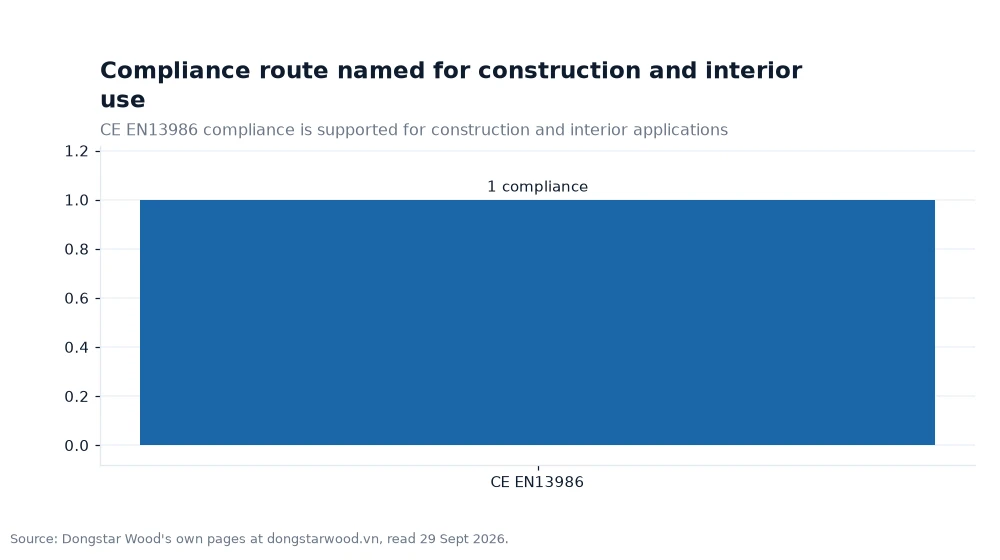
- CE EN13986 is the compliance route named for construction and interior use.
- Low-emission glues E1 and E0 are the published adhesive options.
- Sizes run from 1220 × 2440 mm through 1250 × 2500 mm to 1250 × 3000 mm, and custom panels reach 1830 × 3830 mm.
Why weight matters in a fit-out
In a marine fit-out every kilogram counts. The panel that lines a cabin ceiling or forms the base of a galley counter adds weight to a structure that already carries engines, rigging and stores. A hardwood that is too heavy for overhead installation forces the shipyard to redesign the framing, which is time and money spent on the wrong problem. Choosing a panel that is light by nature rather than by compromise removes that cost before it appears.
The client's own description of the material positions it as relatively low density compared to many hardwood plywoods, which makes it easier to handle while keeping dimensional stability. That balance is the reason boat builders reach for the material: it is light enough to lift without equipment, yet stable enough to hold its shape across the temperature and humidity swings a vessel encounters.
The pale red face
The face of the panel is its first quality in a fit-out, because it is the surface the owner sees. Okoume produces a natural veneer with a pale red to pinkish tone and a uniform grain structure, and the uniformity is what makes the panel useful in visible joinery: it takes paint, stain, laminate and clear sealers evenly, without the grain variation that forces a shop to sort sheets before they reach the bench.
The face also tells the shipyard something about the panel's construction. A uniform veneer over a stable core suggests calibrated pressing and controlled moisture, which are the conditions that keep a panel flat after it is installed. A buyer who knows the face is pale red and uniform can specify the finishing system — paint, stain or clear — without worrying that the substrate will fight the finish.
Density and dimensional stability
Low density in a hardwood panel is a property to manage, not a weakness to apologise for. The client describes the material as relatively low density compared to many hardwood plywoods, which keeps panel weight down for overhead and vertical applications where the load on fasteners and framing matters. The same property keeps dimensional stability high, because a lighter panel moves less with moisture change.
The result is a panel that tolerates the cut-and-drill routine of a shipyard without losing its shape. Calibrated veneers and precision pressing produce a tight thickness tolerance, which means a batch of panels specified at a given thickness arrives at that thickness and stays there through machining, sanding and installation. The tight tolerance is what lets a joiner run a CNC path on one sheet and get the same result on the next.
CE EN13986 for construction and interior use
Compliance is the paperwork that opens a market. The client's own pages name CE EN13986 as the compliance route supported for construction and interior applications, and for a European buyer that documentation is the paper that lets the panel enter a building or a marine project. Without the route the panel is a panel; with it, the panel is a documented product that can be specified in a project plan.
CE EN13986 covers structural performance as well as emission behaviour, which means a buyer can specify the same panel for a load-bearing application and an interior lining without changing the compliance file. The breadth of the route is the reason a shipyard can use one supplier for both the hull's internal structure and the cabin's visible joinery.
Glue classes and finishing options
The glue class determines how the panel behaves in the conditions it will meet. Low-emission glues E1 and E0 are the published adhesive options for interior work, and phenolic or melamine systems serve the marine-adjacent applications where moisture exposure is higher. A buyer should name the glue class in the specification, because the same face over two different glue lines is two different products in service.
Finishing options follow the glue class. E1 and E0 boards take paint, stain and clear sealers without bleed marks from the adhesive line, which keeps the visible surface clean. Phenolic systems serve the parts of the vessel that see water but do not need the finish quality of a cabin interior. The specification is the document that keeps these two worlds apart.
Applications named for the panel
The client names marine, furniture, interior decoration, cabinetry and architectural designs as the uses for the material. In practice, the applications cluster around two profiles: the visible joinery of a yacht or home — chairs, tables, cabinets, wardrobes, wall cladding, ceiling panels, doors, trims and decorative accents — and the lighter structural elements of a boat's interior where the panel must hold its shape without adding excessive weight.
The architectural applications deserve attention from buyers outside the marine sector. The same pale red face that fits a yacht cabin fits a residential interior or a commercial fit-out, and the CE EN13986 compliance route covers both marine-adjacent and land-based construction. A specification that works for a boat's galley works for a hotel kitchen.
| Property | Published description | Fit-out relevance |
|---|---|---|
| Face | Naturally pale red to pinkish tone, uniform grain | Visible joinery without grain sorting |
| Density | Relatively low compared to many hardwood plywoods | Light weight for overhead and vertical panels |
| Glue options | E1, E0 (low-emission); phenolic, melamine (moisture-resistant) | Matches the glue class to the exposure level |
| Compliance | CE EN13986 | Documentation for construction and interior use |
| Sizes | 1220 × 2440; 1250 × 2500; 1250 × 3000; custom max 1830 × 3830 mm | Standard and non-standard fit-out geometries |
Worked example: sheets for a cabin fit-out
Begin by converting the design area into sheet counts. One standard 2500 × 1250 mm board covers 3.125 m², so a fit-out of 40 m² requires 40 ÷ 3.125 = 12.8, which rounds to 13 sheets for full coverage plus waste. A fit-out of 80 m² requires 80 ÷ 3.125 = 25.6, so 26 sheets. The arithmetic is simple, but it converts a design drawing into a purchasing number before the quotation is requested.
Now compare formats. The same 40 m² at 1220 × 2440 mm requires 40 ÷ 2.98 = 13.4, so 14 sheets; at 1250 × 3000 mm it requires 40 ÷ 3.75 = 10.7, so 11 sheets. The largest format cuts three sheets from the order, which is three fewer deliveries, three fewer sets of wrapping and three fewer chances for a panel to arrive damaged. The format decision is a logistics decision.
Frequently asked questions
What gives okoume its pale red tone?
The pale red to pinkish tone is natural to the species, which is native to Africa. The uniform grain structure of the veneer makes it suited to finishing, laminating and painting without the grain variation that forces sorting before installation.
When is CE EN13986 documentation relevant?
When the panels are destined for construction or interior applications in European markets. CE EN13986 covers structural performance and emission behaviour, so a single compliance file can cover both load-bearing and visible joinery.
Which adhesives are used in these panels?
Low-emission glues E1 and E0 for interior work, and phenolic or melamine systems for marine-adjacent applications with higher moisture exposure. The glue class should be named in the specification to match the panel to the conditions it will meet.
From specification to cabin
A marine fit-out panel earns its place when the weight, the face and the compliance match the project. Okoume Plywood Supplier pages describe the pale red face, the low density and the CE EN13986 compliance that fit a yacht or a home. See the birch plywood page for the heavier hardwood panels that anchor furniture lines on land, and the CDX pine plywood page for the construction-grade panels that support the structure behind the visible fit-out. A shipyard that specifies the panel, the glue and the compliance together tends to find the installation goes up without the rework that a vague specification invites.
Values used throughout were lifted from the manufacturer's pages at dongstarwood.vn accessed 29 Sept 2026[1].