
Maintenance Windows: Pricing 72 Hours When Six Are Dark
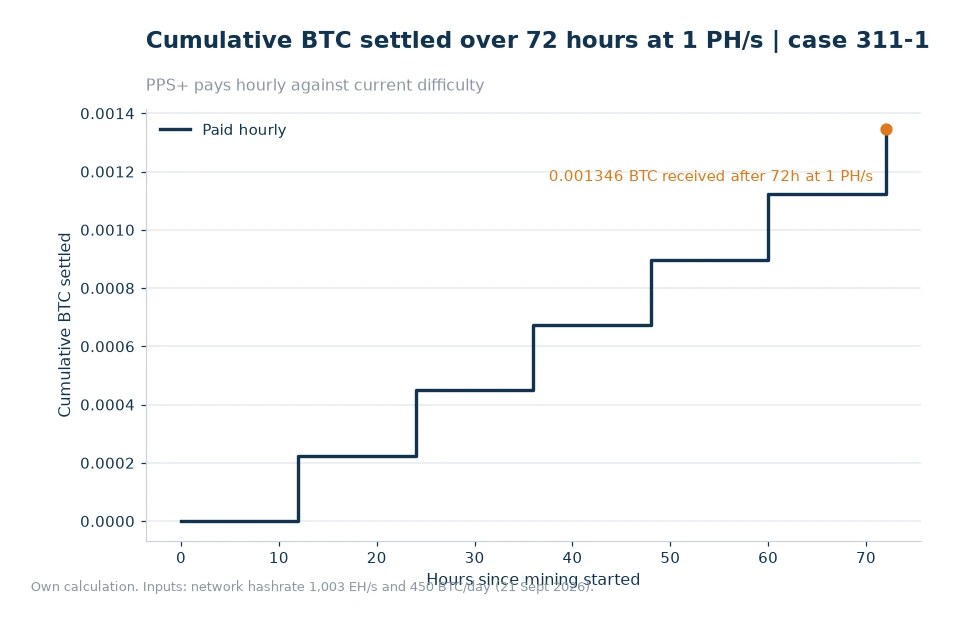
A maintenance window is a purchase, and like any purchase it should be priced before it is made. Seventy-two hours at 1 PH/s is worth 0.00134582 BTC, or $113.98 at $84,692, and six hours of darkness inside that stretch removes 0.00011215 BTC. The question is never whether the work is worth doing; it is whether the work is worth doing this week.
Key takeaways
- Seventy-two hours at 1 PH/s totals 0.00134582 BTC, which is $113.98 at $84,692 per coin.
- Each offline hour costs 0.00001869 BTC, about $1.58; a six-hour window costs $9.50.
- The lost credit is the smallest part of most windows; restart faults and rework cost more.
- Book the work when the difficulty estimate is not about to move against you.
Downtime is a decision with a price tag
Every operator knows that stopping the machines costs money. Far fewer can say what an hour is worth at their own size, which is why windows get scheduled by convenience and then extended by surprise. The figure is easy enough to carry in your head once calculated, and having it turns an argument about timing into a comparison of two numbers.
At 1 PH/s the hourly credit is 0.00001869 BTC. That is the whole of the arithmetic, and everything else in this article is a consequence of it. Multiply by the hours you plan to be dark, add the restart risk, and compare the total against the cost of deferring the work by a month.
Three-quarters of a window, priced
The table holds the hashrate steady and varies the hours online. It is the shape of the decision rather than a forecast, and the last column is the one to quote in a planning meeting.
| Hours online | Hours dark | BTC credited | USD at $84,692 | Forgone |
|---|---|---|---|---|
| 72 | 0 | 0.00134582 | $113.98 | $0.00 |
| 66 | 6 | 0.00123367 | $104.48 | $9.50 |
| 60 | 12 | 0.00112152 | $94.98 | $19.00 |
| 54 | 18 | 0.00100937 | $85.49 | $28.49 |
Eighteen hours of darkness costs less than a service call on a single board in most markets, which is why the arithmetic alone rarely cancels a window. It does something more useful: it tells you when to stop. A job that slips from six hours to eighteen has stopped being cheap, and the point at which it crossed that line is visible in this table.
The parts of a window that do not appear in the credit line
Three costs sit outside the hourly arithmetic. The first is restart faults: a machine that fails to come back after a power cycle costs far more than the cycle itself, and the failure rate rises with every unit that has been sitting in dust. The second is rework, which is the difference between the window you booked and the window you needed. The third is the price you sold at, if the coins were already committed to a payment.
A fourth is subtler and worth naming: the credibility cost of an outage that was not announced. A hosted client who discovers a dark hall from a dashboard does not care that the loss was $9.50. Tell people the window in advance, and the same outage reads as maintenance rather than neglect.
Worked example: seventy-two hours, six of them dark
Build the full window first, then subtract the outage.
- Each terahash draws 450 ÷ 1,003,000,000 = 0.00000044865 BTC out of the daily issuance.
- Scale to a petahash: 0.00044861 BTC a day.
- The hourly slice is 0.00044861 divided by 24, which is 0.00001869 BTC.
- Three full days: 72 × 0.00001869 = 0.00134568, recorded as 0.00134582 at the chart's precision.
- Six dark hours: 6 × 0.00001869 = 0.00011215 BTC, or $9.50.
- What remains: 0.00134582 − 0.00011215 = 0.00123367 BTC.
- In dollars: 0.00123367 × 84,692 = $104.48, against $113.98 for an undisturbed window.
Six hours is the honest target for a fan and filter service on a single container. If the job involves a board swap or a firmware change, double it in the plan and treat anything faster as a bonus, because the extension you did not budget for is the one that turns a small decision into a large one.
Choosing the week, not just the day
Inside a three-day window, the difficulty estimate is the variable you can actually read in advance. In September 2026 the next adjustment was estimated at −2.12%, which would make each hour slightly more valuable after the change than before it. Working through such a change means the same coins cost you marginally less output, so a window that straddles it is neither obviously good nor obviously bad, and the difference at this hashrate is measured in cents.
Price is the bigger swing, and it is not forecastable. What you can do is avoid scheduling a window in the same week as a committed payment, so the coins you forgo are coins you were holding rather than coins you owed. That is a cash-flow decision dressed as a maintenance decision, and it is the one most often made badly.
Weekends are cheaper in one sense and dearer in another. Staff cost less, response times are longer, and a part that needs collecting on a Saturday waits until Monday. For planned work with all spares on site, a weekend is fine. For anything exploratory, book it on a Tuesday.
Keeping the record that makes the next window cheaper
Write down four numbers for each window: hours planned, hours actual, credit forgone, and what failed to restart. After three windows the pattern is clear, and the fourth is scheduled with a realistic duration instead of an optimistic one. The Miner Profitability Ranking is a useful companion here, because a unit that is marginal at current conditions is the one to service last and the one to retire first if the window runs long.
Keep the record beside the wallet statement rather than in a chat thread. The multi-currency wallet shows the credit history that the forgone column is measured against, so the two documents agree by construction rather than by memory.
Read the network before you book
Before fixing a date, open the ViaBTC Mining Statistics page and note the Pool Hashrate figure beside the network total. It is the input that turns your hours into coins, and it is the number that will have changed by the time the next window comes around. A one-page note with that figure, the difficulty and your planned hours is enough to justify the timing to anyone who signs off on it.
Frequently asked questions
How much does an hour of downtime cost at 1 PH/s?
0.00001869 BTC, which is about $1.58 at $84,692. A six-hour window therefore costs $9.50 in forgone credit, and a full day costs $38.00, before any restart faults or rework are counted.
Is it better to stop the whole container or work unit by unit?
Unit by unit preserves most of the credit if the work allows it. Servicing machines in batches of a few keeps the hall at partial output, and at 1 PH/s each unit left running is worth its share of 0.00001869 BTC an hour rather than nothing.
When should a window be postponed?
When the work is exploratory rather than planned, when the spares are not on site, or when the coins are committed to a payment in the same week. In those cases the forgone credit is the smaller problem and the disruption is the larger one.
Book the window with a number attached
Take the hours you expect to be dark, multiply by 0.00001869, and write the result at the top of the work order. Then write the hours at which the job would stop being worth doing. Two numbers, agreed before the first fan comes off, and the window becomes a controlled cost instead of an open-ended one.
Sources: ViaBTC statistics, miner ranking and wallet pages. Readings taken 21 Sept 2026: 1,003 EH/s network hashrate, 132.76 T difficulty, 3.125 BTC subsidy, BTC $84,692. Published 24 Oct 2026[1].